
| Aged care report card |
Friday, 12 December 2008 10:00 |
Print page: |
|||||||||
Aged Care in Australia 2007 – 2008The Minister for Ageing, Justine Elliot, commented in her media release on 25 November, 2008:
The Minister made further comment in her media release on 26 November, 2008: "The data speaks for itself. It shows the vast majority of nursing homes are providing a world class service, but there is a small group - 46 nursing homes - that had failed to meet 44 accreditation standard outcomes under the Aged Care Act." In SummaryThe Minister also states in the Report on the Operation of the Aged Care Act 1997 - 1 July 2007 to 30 June 2008: "only 1.6 per cent of homes (46 homes) were identified as having some non-compliance in respect to the 44 Accreditation Standard expected outcomes" Our records indicate that at least 108 (3.8%) of aged-care homes did so. Aged Care Crisis have been open and transparent by publishing our analysis and findings, together with the supporting data. We wrote to the Minister prior to publishing our findings, seeking clarification of the discrepencies, together with the data source available to us at the time. This is based on information that we have been able to access published on-line (at various stages) by the Aged Care Standards and Accreditation Agency (ACSAA) and the Department of Health and Ageing (DHA). Based on the limited information that is publicly available, the data may not be contemporaneous and these findings are tentative. Update - 16 Dec 2008:
IntroductionThe Aged Care Act 1997 heralded a major change in the provision of aged care in Australia. Care of the aged and infirm was turned into a commodity which was able to be traded in the market place. It is astounding that, ten years later, the Department of Health and Ageing has provided no detailed evaluation of this major development which has affected so many frail, older Australians. A lack of full transparency by all authorities responsible for monitoring this process has prevented other interested parties from doing so. The Aged Care Crisis Team now calls for a complete, open review of the Aged Care Act 1997, and asks for a thorough examination and analysis of all aspects of aged care. The sector, and those it serves, deserves no less. The Aged Care Crisis Team has gathered information from various sources during the last few years but it is necessarily incomplete. We were stimulated to closely examine some of this data as documents in our possession indicated that more than twice the number of facilities failed full accreditation than the 46 claimed by the Minister for Ageing in her media releases. Based on the limited information that is publicly available, the data may not be contemporaneous and these findings are tentative. What is clear is that useful information, on which public policy and democratic debate should be based, is not fully available to public scrutiny. Particularly worrying is that a system based on market place dynamics conceals the information which citizens require to make effective decision making. Frail citizens and their families are therefore unable to make rational choices when selecting a nursing home. As well, hospital and community social workers are unable to appropriately advise them. Many families contact the Aged Care Crisis Team about failures in care. We suspect that the incidence of failure is far higher than that detected and published by the Aged Care Standards and Accreditation Agency and the Department of Health and Ageing. At present we have no way of confirming this. We stress that there are two issues here - the validity and effectiveness of the accreditation process and the actual accreditation findings. Our present analysis examines the assessment findings but does not address their validity or effectiveness. We invite the Aged Care Standards and Accreditation Agency, the Department of Health and Ageing and the Minister to make all relevant reports and documents relating to the providers of aged care publicly available, and if our information does not reflect the true situation, to offer a more accurate analysis. We invite them to explain any discrepancies. The dataThe Aged Care Crisis Team had collected reports on 108 aged-care homes in which one or more of the 44 accreditation standards were found wanting and/or sanctions were imposed during the period when the Minister reported just 46. A list of the 108 aged-care homes in this analysis is provided on a separate page. The analysis appears to be representative and we believe give an indication of trends within the sector. We have included those aged-care homes where our records show that they failed non-compliance between 1st July 2007 and 30 June 2008 and/or were sanctioned during this period indicating that failures persisted. Earlier failures were excluded unless sanctions were imposed during the study period. We note that some nursing homes and hostels, particularly in rural and remote areas, although having similar names, are separately registered and assessed. They appear to be co-located but separate. We have treated them as such. We have analysed this information looking for pointers to what is happening. Further studies based on complete data are urgently needed to confirm the validity and the independent impact of the different factors examined. AnalysisDistribution of aged-care homesAs of June 30, there were 2,838 Commonwealth-funded aged-care homes in Australia. The proportion of aged-care homes, expressed as a percentage figure, is shown in Figure 1 (below). The Minister’s report and other data available to us indicate that not-for-profit groups operated 1,698 (59.7%) homes. Of these 821 (29%) were run by religious groups, 481 (17%) by charities, and 396 (14%) by community based groups. Governments operated 198 (7%) and private-for-profit operators 942 (33.7%). This categorisation is based on a document which we believe originated within the Department of Health and Ageing. Distribution of aged-care homes not meeting at least one required standardThe distribution changes when the 108 facilities that failed at least one accreditation standard are examined. Private-for-profit 47 (44%), government 12 (11%) and community-based not-for-profit 23 (21%) each had an increased proportion of the failed homes. In contrast, charitable 10 (9%) and religious not- for-profit 16 (15%) had a much smaller proportion. They accounted for only a quarter of the failed aged-care homes even though they operate nearly half of all aged-care homes (Figure 2) In Figure 1 (left), the proportion of all 2,838 Australian nursing homes by approved provider type (left) compared with Figure 2 (right) the proportion of 108 Australian nursing homes that had some non-compliance by approved provider type. Note that the charitable and religious groups have halved the proportion of the failed homes whereas the other three have increased indicating that the problem homes lie mainly here. Incidence of failuresUsing the figures above it was possible to calculate the proportion of aged-care homes failing an accreditation standard in each group and then compare the rate of accreditation failures for each to give an indication of performance in Figure 3 (below): The best performers were the charitable and religious not-for profit sub-groups. They had less than half the rate of private-for-profit providers and almost one third the rate of government-run and community-based not-for-profit aged-care homes. A more accurate, but still not fully comparable comparison between the private-for-profit and not-for-profit providers, is given by comparing the for-profit private providers with the charitable and religious not-for-profit groups only. The latter operate fewer peripherally located failing services (23%) than the government and community based groups (63%). Only 4% of the failing private-for-profit providers are peripheral with 96% central. When compared with the charity and religious groups, the private-for-profit operators had more than double the proportion of failing homes - see Figure 3 (above). Number of standards failedThe average number of the 44 accreditation standards failed did not differ much between the various groups. The charitable and not-for-profit religious organisations had fewer but the numbers were insufficient to draw any firm conclusions. Government operated aged-care homes averaged 10.7 failures, community-based not-for-profit 9.7, not-for-profit charitable 6.0, not-for-profit religious 6.9 and private-for-profit 9.0. The impact of distanceIsolation by distance from major centres and medical services is likely to be associated with limited management resources, fewer trained staff, and less oversight by parent organisations and other bodies. They are therefore at a disadvantage. The differences in distribution between peripheral groups of aged-care homes in outer regional, remote and very remote areas - when contrasted with central groups comprising inner regional and major city areas - is striking. These readily account for the differences seen between the government and community-based groups on the one hand and the charitable and religious groups on the other. Both are more likely to serve those in need in their own localities.
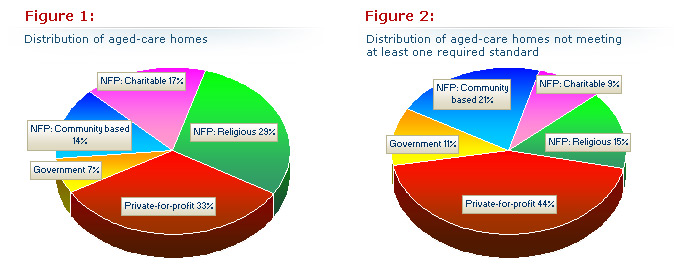
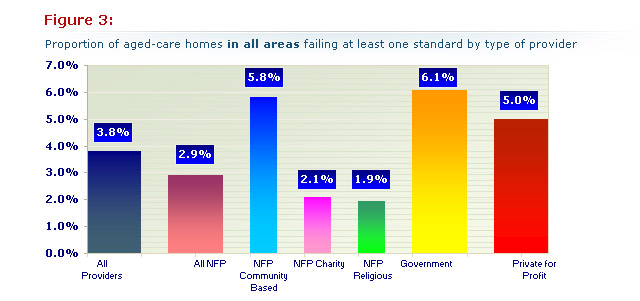
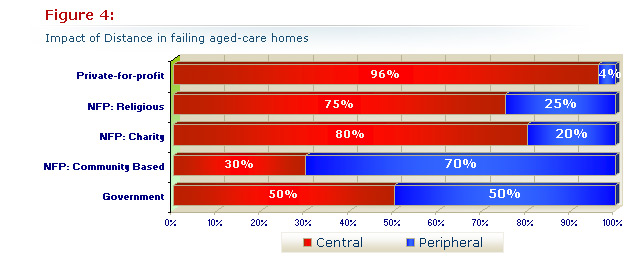
Figure 4 (above), shows the proportion of the 108 nursing homes failing at least one standard owned by each sort of provider group in central and peripheral areas. The impact of private-for-profit control of aged careAs a more peripheral location clearly was associated with failures in standards we re-examined the data after excluding all of the peripheral facilities. To get the information we needed we used a different data source with 2,937 (107 more facilities) listed in Australia. This was not a significant difference, We excluded 427 peripherally located facilities leaving 2,510 more central ones for analysis. When we excluded the 30 peripherally located aged-care homes that had failed a standard we were left with 78 that were centrally located. The distribution of both groups by provider group as well as the rate of failure is shown in Table 1 (below):
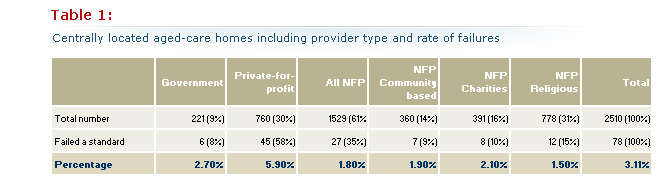
The percentages of failed aged-care homes graphed in Figure 5 (below) can be compared with Figure 3. The bias created by distribution has disappeared so that government and not-for-profit subgroups now perform similarly. The private-for-profit sector stands out with more than twice the incidence when compared with government, over three times when compared with all not for profits and almost four times when compared with the largest not-for-profit group, the religious providers.
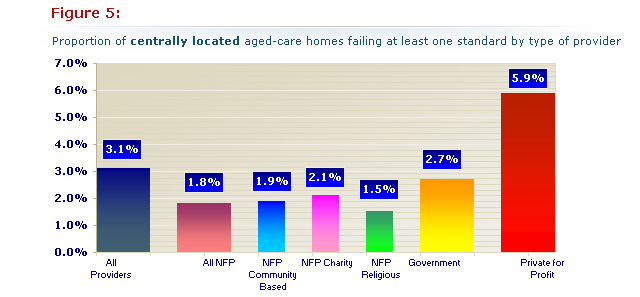
Figure 5 (above): Note that the change in distribution in each group differs from our first analysis (Figure 3), in that the private-for-profit sector has more than double the rate of failing aged-care homes than all the other groups which now perform comparably. DiscussionThe data indicates that peripherally located nursing homes are disadvantaged and need greater integration and support. The size of the provider organisation and the managerial resources and experience it can bring to its operations are clearly important. Our impression is that providers with fewer aged-care homes are both more likely to fail accreditation standards and more likely to have more than one home fail. The complexity of the managerial and corporate structures in both the private-for-profit and the not-for-profit sectors coupled with the lack of transparency in these matters would make any attempt to analyse or draw firm conclusions in this regard from our limited data prone to error. We have not attempted to do so. In looking at factors other than the provider type that might influence the results and produce the other changes, we feel that the imbalance in our outcomes might be partly biased in that the not-for-profit religious and charity subgroups have fewer small operators who also seem to be more at risk. It is unlikely that this would account for all the difference. If this is so, then this has policy implications. Private-for-profit operators generally serve the more affluent sections of the community in centrally located areas. We feel that they should not lack for resources or community support. As indicated earlier we did not have the information needed to evaluate the impact of these and other factors. The market makes claims to greater efficiency but if so then these results suggest that this does not extend to improving accreditation outcomes. It is clearly essential that these results be validated by a much larger study including all the data from the last 3-4 years and including an assessment of corporate and management size and structure. We are deeply concerned that these findings are a consequence of the diversion of financial and human resources from the care of residents to the care of profits. The industry’s own figures lend support to our concerns. The December 2008 Aged Care Association of Australia's (ACAA) submission (pages 6-7, Graph 2-Graph 3) to the Australian Senate Finance and Public Administration Committee reveals that the profit margin of for profit nursing home operators (16%) is double that of not-for-profit operators (8%). It also reveals that private-for-profit providers make three times the net profit from each bed ($3,000 vs $1,000). Our results suggest that this has consequences. We are also concerned that this may be a red flag pointing to a pervasive change in ethos and a consequent malaise in the sector; a malaise, pointed to by the number of nurse whistle blowers, falling staff levels, rising community concern and the succession of scandals since 2000. If these findings are replicated in a more thorough study then this would be a serious indictment of the policies embarked on in 1997. In the USA, where far more detailed information is publicly available, most studies comparing not-for-profit and privately-operated corporate owned aged-care nursing homes have, over the years, found that the latter have about 3 times as many problems. It is interesting that our findings are similar. We suspect that a more comprehensive study would confirm this as well as identifying the impact of other factors. ConclusionsThe admittedly limited data available to us indicates that government and community-based not-for -profit operators have more than double the incidence of aged-care homes failing at least one accreditation standard when compared with other not-for-profit providers. This is readily accounted for by the number of facilities located in more remote areas of Australia. Private-for-profit operators which operate almost entirely in central areas have a similarly higher incidence of aged-care homes not meeting required standards. It has not been possible to evaluate all of the factors which might impact on this. It concerns us that the difference may be because human and financial resources are being diverted from the care of residents to the business of extracting profits from the sector. Further investigations to confirm the validity of these findings and to evaluate the impact of the other factors at work are required. We urge the government to make data publicly available so that academics and members of the community can bring their many skills to an evaluation of the issues, and their talents to addressing the way ahead. The baby-boomer aged-care bulge is upon us and to do otherwise would be irresponsible. We cannot afford to squander our country's talents. Comments on the dataWe are somewhat confused by the varying use of terminology within the Minister's media releases and announcements. We assume that, although the Minister refers to 46 homes that failed to meet required standards in her media release of 25 November 2008 [Release of annual report – Operation of Aged Care Act 2007-2008], she was actually referring to both nursing homes and hostels – 1.6 percent of all aged-care homes. Comments on the lack of transparencyAn unfulfilled promiseThe Rudd government has promised greater transparency in all spheres of government but there is little evidence of this within the aged-care sector. We believe that the issue of increased transparency was largely ignored in the November 2008 revision of the Aged Care Act 1997. It is our view that both the Accreditation Agency and the DHA should collect and collate all information relating to the provision of aged care and ensure that it is readily accessible to all. We also believe that there must be far more involvement from communities and much more community input into all aspects of aged care – including the accreditation process. Accreditation and transparencyThe current limited system of late release and early removal of adverse reports from the Aged Care Standards and Accreditation Agency website is unsatisfactory. Consumers are entitled to disclosure of all past, as well as present, reports. Information needs to be presented in a digestible format. As already stated, frail older people are one of the most vulnerable groups in society and their protection should outweigh all other considerations. In order to achieve this protection, community members must be able to see what the company or provider is capable of when no one is watching - not just when they have been given time to prepare for an inspection and not simply after providing a response to an adverse finding in order to stay in business. Newer articles:
Older articles:
|
|||||||||
Aged care report card

reply from the Minister's office 


